The powdered sorts have to be blended with water before use, and so could be considered to belong to the liquid category. After making use of the stencil remover the emulsion have to be washed out utilizing a pressure washer. Textile objects are printed in multi-color designs using a wet on wet approach, whereas graphic items are allowed to dry between colours which are then printed with one other display and sometimes in a special color. Tube printing using complicated and specialised printing machines similar to silk display screen printing applies the specified decoration.
It’s extra of a conveyer belt sort device that has been set to a precise temperature to make sure the shirts dry in a single move and the colors don’t bleed. We take our custom colours and begin mixing and matching till we've the precise colours that you just specified. We solely use high-quality inks which are designed to last a very lengthy time. The inks we use are also actually thick, which means the design goes to come out trying actually good. Additionally, reproductions are printed by the hundreds, and there's no physical restrict to the variety of impressions, because the matrix doesn't wear down.
A blade or squeegee is moved throughout the display to fill the open mesh apertures with ink, and a reverse stroke then causes the screen to the touch the substrate momentarily alongside a line of contact. This causes the ink to moist the substrate and be pulled out of the mesh apertures because the display screen springs again after the blade has passed. One color is printed at a time, so several screens can be utilized to supply a multi-coloured picture or design.
After the filler had dried, water was used to spray out the display, and solely the areas that had been painted by the drawing fluid would wash away, leaving a stencil round it. This course of enabled the artist to incorporate their hand into the process, to stay true to their drawing. A display is made of a chunk of porous, finely woven fabric referred to as mesh stretched over a body of aluminum or wooden.
The operator then makes use of a squeegee to maneuver the mesh down to the substrate and pushes the squeegee to the rear of the screen. The ink that's in the mesh opening is pumped or squeezed by capillary action to the substrate in a controlled and prescribed quantity, i.e. the moist ink deposit is proportional to the thickness of the mesh and or stencil. Credit is given to the artist Andy Warhol for popularising display printing as an inventive technique. Warhol's silk screens embrace his 1962 Marilyn Diptych, which is a portrait of the actress Marilyn Monroe printed in bold colours. Warhol was supported in his production by master display printer Michel Caza, a founding member of Fespa. Both of these methods block UV waves, which is important because after your brand is applied to the display screen, it goes underneath a UV mild.
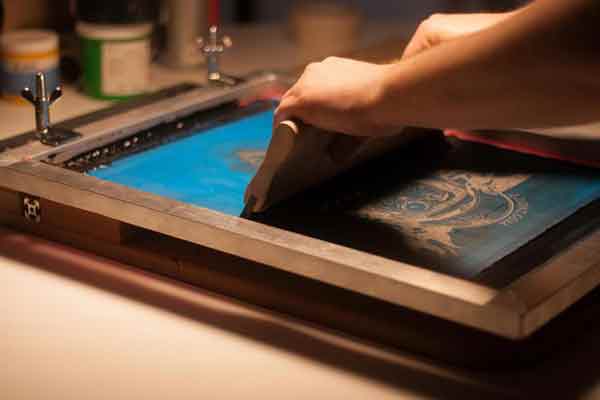
There are several methods to create a stencil for screen-printing. For a extra painterly technique, the artist would choose to paint the image with drawing fluid, wait for the image to dry, after which coat the whole screen with screen filler.
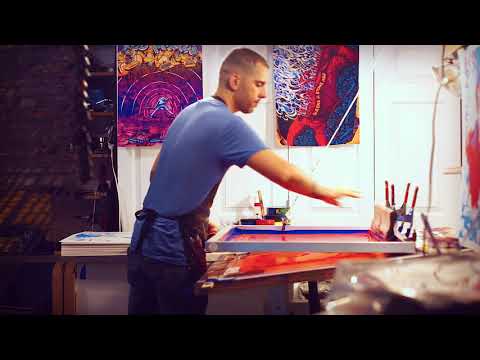
Silkscreen Printing is a stenciling methodology that involves printing ink through stencils which are supported by a porous material mesh stretched across a frame called a display screen. Silkscreen Printing is ideally suited to bold and graphic designs.
Most usually, a banner is adorned with an activist slogan or picture using paint, dye or, in some circumstances, display printing. Fabric "adinkra" are often made by woodcut signal writing as properly as display screen printing. Through custom-made courses and workshops, designers and entrepreneurs achieve entry to pro-level software program and screen printing equipment.
The silver halide crystals, that are light-sensitive, relaxation within the gelatinous material; they are often incorporated onto quite so much of mediums similar to paper, plastic, fabric, or glass in the course of the manufacturing course of. In images, the silver halide reacts to the chemical substances used in the movie creating stage, which produces the image from the film on the photograph paper. It's a slightly totally different process in phrases of promotional products. Credit is usually given to the artist Andy Warhol for popularizing screen printing identified as serigraphy, within the United States. Warhol is particularly recognized along with his 1962 depiction of actress Marilyn Monroe screen printed in garish colors. Originally a profitable industrial know-how, display screen printing was finally adopted by artists as an expressive and conveniently repeatable medium for duplication properly before the 1900s. It is currently in style both in fine arts and in business printing, where it's generally used to print images onT-shirts,hats, CDs, DVDs, ceramics, glass, polyethylene, polypropylene, paper, metals, and wood.
This type of printing is deal for artwork that solely has 1-2 colors or huge portions. Picture a 12-armed steel beast from some mythical Viking story. On each arm there is place the place the wooden silk display is placed. We additionally deal with some behind-the-scenes stuff to get ready for a print run. This total arrange for silk screening is for much longer than DTG printing as we have to manually do everything by hand. Here’s an in-depth overview of how we go about display printing our t-shirts. ” upbeat industrial-sounding music and let’s dive proper in to the fantastic world of silk screening t-shirts.
This is why most industries rely on technical glossaries that make it possible to speak not solely inside one’s own company, however throughout the complete trade. In Germany, technical phrases are collected not solely in glossaries, however are also codified in DIN specifications that present requirements for word usage between industries. However, the emulsion process remains to be one of the most efficient methods to imprint logos onto promotional products. Emulsion is great for tote luggage, nevertheless it also works for spherical products similar to tumblers or pens.
While historically individuals have used silk screening for placing designs fastidiously on t-shirts, recently new strategies have been adopted such as digital printing on shirts using frequent consumer-quality inkjet printers. Silk screening, nevertheless, has remained an attractive supply of excessive quality prints on shirts.
Screen printing derives from older practices of stencil printing, such as the pochoir technique of stencilling. Essentially, a design is reduce or punched into a sheet of paper, metallic, or other materials, and ink is utilized with a brush to the floor of the stencil, where it passes through the openings onto the specified floor. Stencil printing was popular in Japan until the early nineteenth century, and early forms of European stencil printing date again at least to A.D. In 1914, American John Pilsworth devised a system for the silkscreening of banners, and until the late Nineteen Thirties screen printing was used primarily for industrial functions, ultimately turning into favored among artists. Screen printing today nonetheless retains the simplicity of earlier forms of it; a hand-cut or photographically-produced stencil is mounted on the underside of a fine mesh screen, which has been stretched taut on a picket body. A fairly viscous ink is positioned on the screen, a glue is utilized to the non-printing areas past the edge of the stencil, and a squeegee pulls the ink down over the stencil, where it prints the design onto the supposed substrate. Screen printing is a printing method that makes use of a woven mesh to help an ink-blocking stencil to obtain a desired image.
To put it merely, emulsion is a substance that is used in display screen printing to get a brand on promotional merchandise. The precise process is named photographic emulsion, and it has been around for a long time. In fact, it was used again within the day to develop pictures. The display is placed atop a substrate corresponding to paper or fabric. Ink is placed on prime of the display screen, and a fill bar is used to fill the mesh openings with ink. The operator begins with the fill bar at the rear of the screen and behind a reservoir of ink. The operator lifts the display to forestall contact with the substrate and then utilizing a slight quantity of downward force pulls the fill bar to the front of the display screen.
Another variation, digital hybrid screen printing, is a union between analog screen printing and traditional digital direct to garment printing, two of the commonest textile embellishment technologies in use right now. Essentially, digital hybrid screen printing is an automatic screen-printing press with a CMYK digital enhancement situated on one of many display print stations. Digital hybrid screen printing is able to variable data options, creating infinite customizations, with the added ability of display print particular strategies. American entrepreneur, artist and inventor Michael Vasilantone started to make use of, develop, and promote a rotatable multicolour garment display screen printing machine in 1960. Vasilantone later filed for a patent on his invention in 1967 granted number 3,427,964 on February 18, 1969. The original machine was manufactured to print logos and staff data on bowling clothes, but was quickly directed to the new fad of printing on T-shirts.
The technique has even been adapted for more superior uses, similar to laying down conductors and resistors in multi-layer circuits utilizing thin ceramic screen printing ink layers because the substrate. However if the design is now not needed, then the screen could be "reclaimed", that is cleared of all emulsion and used once more. The reclaiming process includes removing the ink from the display then spraying on stencil remover to remove all emulsion. Stencil removers come within the form of liquids, gels, or powders.